For CBT-I clinicians
The part of CBT-I that happens without you.
A six-week, self-guided CBT-I program for adults, used between appointments. A two-minute morning diary, sleep efficiency calculated for them, a weekly sleep-window recommendation from a fixed table you can read below, paced lessons, and a coach that answers only from the program's teaching.
Request free clinician accessFree for clinicians. Patients start free; the full program is $14.99 CAD / month or $99.99 CAD a year.
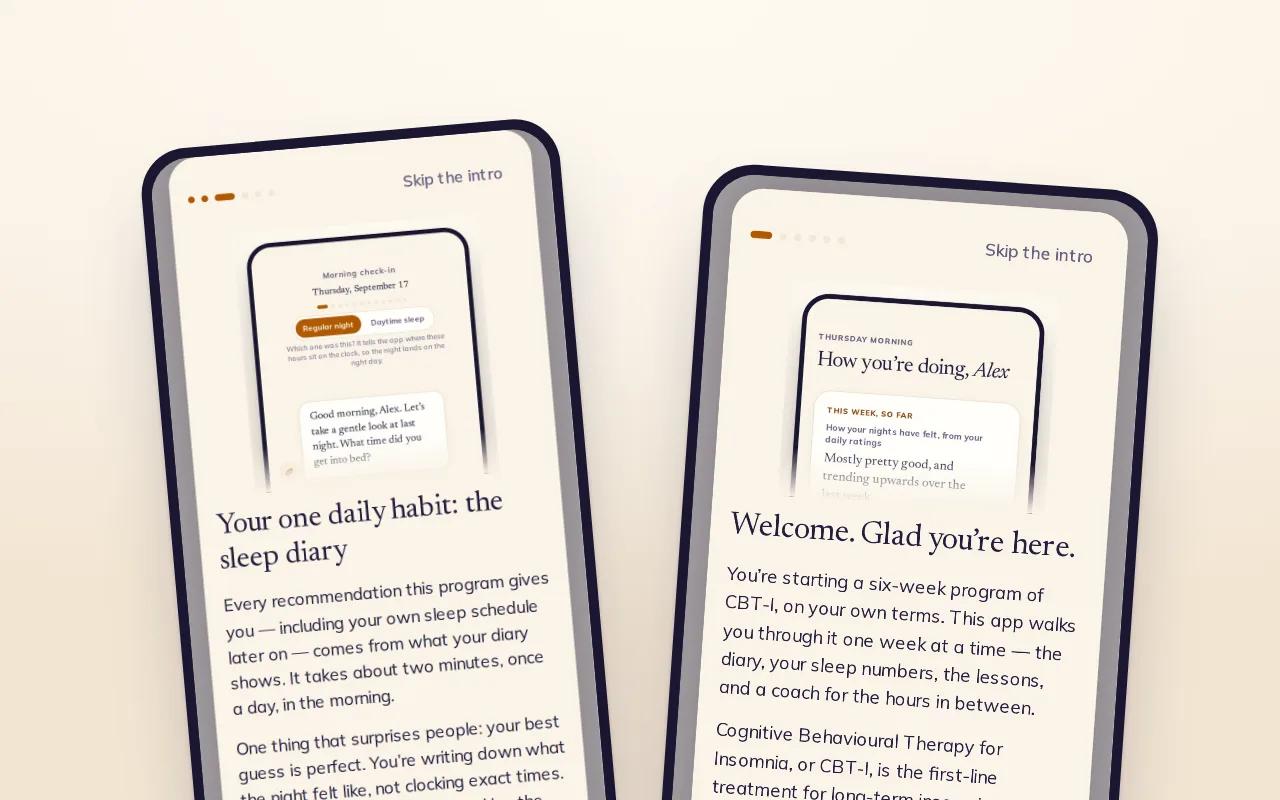
What your patient gets
The between-appointment half of CBT-I, done properly.
- A two-minute morning diaryThe consensus-diary essentials, usual answers one tap away. Naps, caffeine and alcohol sit on an optional second page, for patterns, not the arithmetic.
- Sleep efficiency, calculated for themEvery morning and as a seven-night average, with the trend drawn.
- A weekly sleep-window recommendationFrom the table below. The patient chooses which end of the night to move, which is where most of the adherence is won.
- Six weeks of lessons, pacedSleep drive and the body clock, stimulus control, sleep restriction, cognitive work, relaxation, relapse prevention. One week unlocks at a time.
- A coach for the days between appointmentsPatients ask in their own words, at any hour, and get a real answer straight away. The coach knows their program week, finished lessons, recent nights and earlier conversations. The coach answers only from the program’s teaching material, never improvises clinical advice or discusses changing medication, and refers questions that need you back to you. Nothing is sent on the patient’s behalf.
- Patterns in their own nightsOn request: how their sleep efficiency compared on nights they logged alcohol, caffeine, late meals, activity or a wind-down, over the past four weeks. Comparisons, never causes.
- No sleep score, no nightly verdict, no wearableSleep efficiency and a weekly average, which is what the protocol runs on.
What your patient sees
The screens your patient uses, morning and night.
Screens from the app, filled in with a made-up patient's diary.
Made for clinicians
Two things in the app that are for you, not your patient.
- Clinician notes under the lessons, in early accessLessons across the first five weeks have a note written for the person delivering them, marked “not shown to patients”: what the lesson is doing, where patients tend to get stuck, and how to talk it through. The notes are being reviewed, so they are opened to clinicians one at a time for now; say you would like them on the form. A patient’s phone never receives the text.
- A progress report your patient can hand youA PDF the patient makes from their own diary and emails, prints or brings in, with a short covering note already written. Page one reads in thirty seconds: a summary in words, four headline figures, and three charts on one date axis: sleep efficiency night by night, the prescribed window against time actually in bed, and how each night was made up. Plan B and shift work are explained where they apply. The later pages add anything worth noticing in what the patient logged, naps, and the numbers behind every chart. Fax-safe, with no score or prediction. Only the patient shares it; we never contact you.
The report itself, from the same made-up patient. Tap a page to read it full size.
Page 1 Summary and charts
Page 2 Patterns, naps, weeks
Page 3 Night by night, notes
Screens from the app, filled in with a made-up patient's diary.
Two one-page sheets: one for you, one to hand your patient
The referral sheet is yours: what CBT-I is, who it suits, who to assess first, how to point a patient here, and what they can bring back, with four references. The patient handout is theirs: what to expect, how to start tonight, pictures of the app, and a QR code. Each prints on one page, or download the PDF to save, email or attach to a chart.
Reading for clinicians
Short, referenced articles written for you rather than for patients.
- Digital CBT-I for your patients: what the evidence shows
Guidelines, meta-analyses and trials of digital CBT-I for chronic insomnia, plus dropout data, who to assess first, and how to support a patient using an app.
- No CBT-I therapist nearby? A stepped-care route for primary care
When CBT-I therapists are scarce: a stepped-care route for primary care with brief behavioural treatment, digital CBT-I, medication's place and referral.
Safety and ethics
Built as if your College were reading over our shoulder.
- A version for the patients sleep restriction is wrong forPatients flagging bipolar disorder, seizure history, chronic migraine or pregnancy are offered a full alternative protocol: no fixed bedtime, a consistent rising time, bed only when sleepy. Offered, never imposed.
- Screening before any restrictionBefore the first sleep window, patients are asked about bipolar disorder, seizure history, chronic migraine, pregnancy and other major conditions, and warned about daytime sleepiness and driving. Anyone flagging is offered the no-restriction protocol above. Signs of sleep apnea prompt them to raise it with their doctor.
- A separate safety check on every coach messageIt runs independently of the coach. A second model screens whole conversations for suicidal ideation, acute distress and medication withdrawal. Suicidal ideation and acute distress get crisis resources (9-8-8 in Canada and the US), not sleep advice. Those replies are fixed, clinician-reviewed text. Questions about stopping or tapering medication go back to the prescriber; no dose, rate or schedule is ever stated. 71 of 71 on its test set, re-run on every change.
- It stays in its laneNo diagnosis, no prognosis or medication advice. Small Hours says plainly that it is not a substitute for medical care, and that a patient with a health condition affecting sleep should work through that condition with their doctor.
- Built to stay outside medical-device territoryHealth Canada’s Class II example is AI that tailors mental health treatment plans and outputs a probability of remission. Small Hours does none of that, permanently: the titration table is fixed, not model-computed; nothing touches medication; it emits no score, prognosis or prediction.
What Small Hours is not
It is not a medical device, a diagnostic or a replacement for you. Small Hours delivers the standard, guideline-supported components of CBT-I and makes no outcome claims of its own. Self-guided, for adults. It screens for conditions where sleep restriction is the wrong tool and offers a restriction-free version; patients self-report and can decline. The judgement stays yours.
Privacy, and your role
- Privacy you can defendBuilt to BC PIPA and PIPEDA. Patients can read only their own records, enforced in the database, not just the interface. No advertising, ever; nothing bought from or sold to advertisers. Requests for a copy, correction or deletion of data are answered within 30 days.
- Your patient’s data stays your patient’sWe send you nothing about a patient, and we never ask who their clinician is. If they want you to see their diary, they show you.
- No referral fees. Ever.We do not pay clinicians for recommending Small Hours, in money or in kind tied to volume. Clinician access is free whether you refer one patient or none.
The clinical logic
The sleep-efficiency maths, in full.
CBT-I works; it is first-line for chronic insomnia in the ACP, AASM and European guidelines.
TST = (final wake − sleep onset) − WASO
TIB = out of bed − time tried to sleep
SE% = TST ÷ TIB × 100
Naps are recorded and shown but enter neither term. Sleep efficiency is the share of the night-time sleep opportunity spent asleep, so 100% is the ceiling by construction.
| Average sleep efficiency | Change to time in bed |
|---|---|
| 95% or more | +30 minutes in bed |
| 90 to 94% | +15 minutes |
| 85 to 89% | No change. The sweet spot. |
| Below 85% | −15 minutes, never below 5.5 hours a night |
Minutes go at either end of the night, the patient’s choice. Anyone already waking before their alarm is steered to move their bedtime instead.
Dalhousie’s MySleepWell, funded by Health Canada and CADTH and reported in JAMA Psychiatry, publishes the same four tiers with a 6-hour floor, where our floor is 5.5 hours.
If your protocol titrates differently
Parameters vary: in Kyle’s 2015 review of 88 sleep-restriction trials, 39% reported none and 7% reported them fully. If your protocol titrates differently, that is ordinary, and a matter of minutes. What the app holds to is what the field agrees on: a complete diary, honest arithmetic, a consistent rising time, and education that makes restriction survivable.
What it costs your patient
Diary, sleep-efficiency figures, weekly sleep-window recommendation and the lessons of weeks 1 to 3: free, no time limit. New accounts also get the coach, the progress report and pattern analysis free for 22 days. The lessons of weeks 4 to 6 come with the subscription, $14.99 CAD / month or $8.33 a month, billed as $99.99 CAD once a year, cancelled any time.
Patients sign up themselves; there is nothing for you to set up.
Details for clinicians
Insomnia doesn’t wait for the next appointment.
The hard part is delivery. Treatment happens in the patient’s bedroom, on nights you are not there. Those nights are where treatment comes apart:
- The paper diary comes back half emptyOr filled in from memory in the waiting room. Either way the numbers are soft, and titration rests on them.
- The arithmetic defeats peopleTime in bed across midnight, minus latency, minus WASO, as a percentage, averaged over seven nights. Tired patients get it wrong, and appointment time goes to redoing sums.
- The same questions, between visitsCan I nap? What if I’m not sleepy at my bedtime? Does reading in bed count? Each one is reasonable. Unanswered, each one is a reason for the patient to stop the program.
- The early weeks are where they quitSleep restriction is hardest when the patient is most alone with it. A wobble at 3 a.m. may be days or weeks from your next appointment.
What it does for your practice
- Appointments start from clean dataA complete diary, already averaged, with the trend visible. You open on the clinical question rather than the arithmetic, reading numbers the patient recorded that morning.
- Fewer routine questions between visitsHow-do-I questions get answered in the app as they come up, so what reaches you needs your judgement. Nothing is forwarded to you automatically; the app never contacts you.
- Support through the weeks patients usually quitSleep restriction feels worse before it feels better, and a patient who does not know that reads a bad week as proof the treatment failed. The program tells them, in the lessons and again from the coach when they ask, that sleep efficiency climbs gradually and that a rough week is expected. Patients hear that message on the morning the rough week happens, instead of deciding to stop before you next see them.
- Capacity without diluting careA well-supported patient needs less of you; that matters most with a long wait list. If you run groups, everyone arrives working from the same diary and the same reliably derived numbers.
- Nothing to install, buy or administerPatients sign up themselves; technical app questions come to us through a help link in the app.
How it compares
- A coach that converses, and cannot improviseA patient types a question at any hour and gets an answer written from the program’s teaching material for their week. The coach knows finished lessons, how their nights felt, sleep efficiency against week one, and earlier conversations. The coach cannot invent: replies are assembled only from that material and scanned word by word before showing. Automated programs do not converse, free public-health apps have no coach, and human-coached products work business hours at several times the price.
- A progress report written for you, not a data exportThe patient makes a three-page PDF from their own diary and emails, prints or faxes it to you. Page one reads in thirty seconds: a short summary in words, four headline figures, and three charts on one date axis, with the weeks still to come left blank so every report shares one scale. The first week with a sleep-efficiency figure is set against the latest, the patient’s own window changes are marked apart from the program’s recommendations, and the last page has room for your notes. Free during the patient’s trial, then part of their subscription. The usual alternative is a phone passed across the desk.
- It measures. It does not grade.No sleep score, no nightly verdict, no wearable. Sleep efficiency and a weekly average, which is what the protocol runs on. Patients with insomnia already watch their sleep too closely; an app that adds a nightly grade is treating the wrong thing.
- A free floor that never expiresThe diary, sleep-efficiency figures and weekly sleep-window recommendation stay free forever. A patient who never pays still finishes the protocol with real numbers. Measurement is never paywalled.
- Canadian, and a fraction of the priceBuilt to BC PIPA and PIPEDA, priced at $14.99 CAD / month (or $8.33 a month, billed as $99.99 CAD once a year), and supported by a person in British Columbia who answers email. The nearest comparable programs run from roughly US$90 a month to US$450 for a course.
Where the material comes from
A complete CBT-I course, and every word traces back to it.
The six weeks are a complete CBT-I course built for patients, not a digest of the literature. Every sentence the coach may say traces back to those lessons.
Components: sleep restriction, stimulus control, cognitive work on sleep beliefs, relaxation, supporting sleep hygiene, relapse prevention. Six weeks fits the AASM 2021 guideline’s typical four-to-eight sessions. Diary: consensus sleep diary essentials. Titration table: above.
Being built now
Which arrives first depends on what clinicians say they would use; the form has a place to tell us.
- The rest of a clinician editionPrintable patient handouts and worksheets, and session outlines for one-to-one or group delivery. The clinician notes above are its first part, in early access now.
- Supplementary topicsDesignated worry time, nervous-system regulation, and more on other sleep disorders, for patients whose chronic insomnia is not the whole story.
Clinician access
See everything your patients would see. Free.
Verified clinicians get the whole app free: lessons, coach, pattern analysis. Use it to evaluate the program, to know what a patient sees, or for your own sleep.
Work address: usually you are in once your email is confirmed, and we check your College’s public register afterwards. Personal address: we check the register first, usually a day or two.
Lessons unlock by program week for everyone, including you. To read all six weeks at once, set your start date six weeks back in Settings.
Request access