By Small Hours · Last reviewed
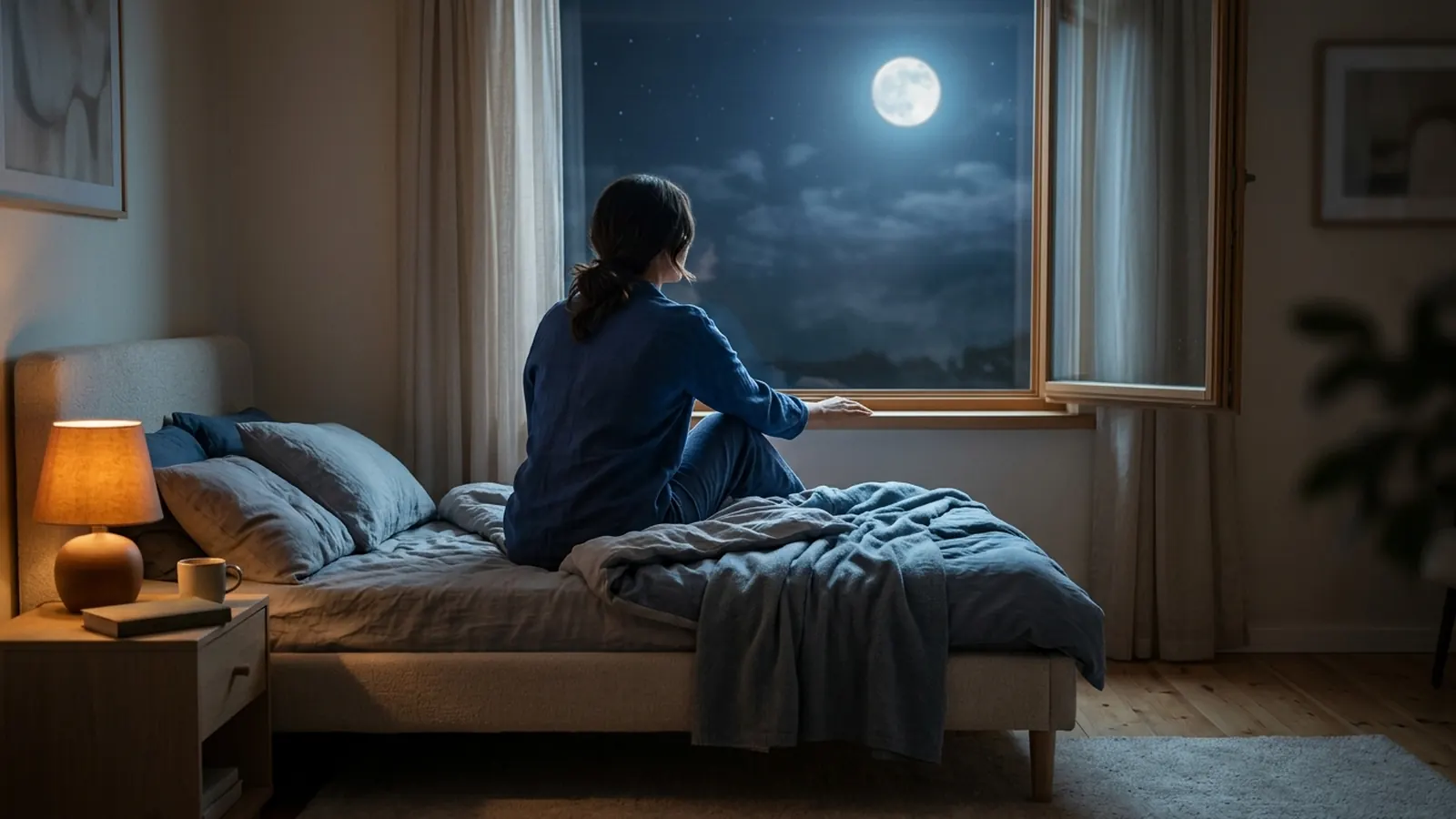
Waking in the small hours and struggling to fall back asleep is one of the most common sleep complaints of the menopausal transition. Research points to several overlapping causes: hot flashes, a more alert nervous system, and other treatable conditions. No study singles out 3 a.m. itself; it is the popular label for waking in the second half of the night. [1][2] This page is about the menopausal transition; for an overview of the whole picture, start with perimenopause insomnia, and for how much night waking is normal at any age, see is it normal to wake up at night.
What the research says
No study names 3 a.m.; they measure waking across the night. In the SWAN study, more frequent hot flashes went with higher odds of trouble falling asleep, staying asleep and waking too early, and early morning waking became less likely between late perimenopause and postmenopause. [2] In a sleep lab of 72 women aged 43 to 57, a hot flash predicted more awakenings per hour, and women with insomnia reported more time awake at night, varying more night to night. [3] When 28 healthy premenopausal women had hot flashes induced by a hormone-suppressing treatment, 66% of the 165 recorded flashes came within 5 minutes of an awakening and 80% just before or during one; only remembered flashes, not those the equipment caught, went with more shifts into lighter sleep. [4] A later lab follow-up found more fast brain-wave activity in non-REM sleep after postmenopause, not explained by reported hot flashes, which the authors read as a more alert nervous system. [5] In plain terms, heat and a more alert brain both play a part.
The studies behind this
- SWAN study (Kravitz, 2008): women reported how many nights in the past two weeks they had trouble falling asleep, staying asleep, or waking too early. More frequent hot flashes went with a higher chance of every one of these. The odds of early morning waking fell between late perimenopause and postmenopause. [2]
- Sleep-lab study (Baker, 2015): in 72 women aged 43 to 57, having a hot flash predicted more awakenings per hour of sleep on an overnight recording. Women with insomnia also reported more time awake at night, and more night-to-night variation in it, than women without. [3]
- Induced-hot-flash study (Bianchi, 2016): 28 healthy premenopausal women were given a hormone-suppressing treatment that brought on hot flashes, then recorded in a sleep lab. Of 165 hot flashes captured, 66% happened within 5 minutes of an awakening and 80% happened just before or during one. Hot flashes the equipment detected were not linked to more shifts into lighter sleep or wake, but hot flashes the women remembered were. [4]
- Sleep-lab follow-up (Matthews, 2021): women who passed into postmenopause showed more fast brain-wave activity in non-REM sleep, and hot flashes they reported did not explain it. The authors read it as hyperarousal, a more alert nervous system. [5]
What is going on when you wake?
Two things can be true at once.
- A hot flash can arrive with, or just before, the waking. In the induced-hot-flash study, most hot flashes came before or at the same moment as an awakening, so the study could not show that the heat caused the waking rather than the reverse. [4]
- Waking also happens without a hot flash. A review notes that many, but not all, hot flashes are linked to awakenings, and that time awake because of hot flashes adds to the total. [1] More on the heat itself in hot flashes and night sweats.
The lab findings carry a second message. Sleep disruption seems to increase awareness and memory of nighttime hot flashes. [4] That helps explain why a broken night can feel dominated by the heat, even when the recording shows less than the memory suggests.
Is it only hot flashes?
No. The causes researchers list include:
- A more alert nervous system during sleep. [5]
- Mood. Some sleep complaints at this stage are tied to depression or anxiety. [1]
- Breathing during sleep. Sleep-disordered breathing is more likely after menopause. [6]
- Movement disorders. The same review names sleep-related movement disorders as more common after menopause. [1]
Why is falling back asleep the hard part?
Our sources describe what is associated with waking, not why returning to sleep is difficult. We would rather say that than guess. What one trial does show is that sleep improved with CBT-I while the number of daily hot flashes did not differ from the control group. [7]
What helps?
- CBT-I (cognitive behavioural therapy for insomnia, a structured treatment that changes the habits and thinking that keep insomnia going). It is the first-line treatment for chronic insomnia in major guidelines. [8][9] The basics are in what is CBT-I.
- In a trial of women with hot flashes, six telephone sessions of CBT-I improved insomnia scores and diary-recorded time to fall asleep, time awake and sleep efficiency more than a menopause-education control did. [7] More in does CBT-I work for menopause insomnia.
- Menopausal hormone therapy is described by The Menopause Society (formerly the North American Menopause Society) as the most effective treatment for hot flashes and night sweats, with a balance of benefit and risk that depends on age, time since menopause, type and dose. [10] Its 2023 statement on non-hormonal options recommends cognitive behavioural therapy, clinical hypnosis, certain antidepressants (SSRIs and SNRIs), gabapentin, oxybutynin and fezolinetant for hot flashes, and does not recommend dietary supplements or herbal remedies. [11] None of this is advice to start, stop or change a medicine; whether any option is right for you is a conversation with your doctor or pharmacist.
We do not publish step-by-step rules for what to do when you wake. They depend on your own sleep records, and the right plan differs from person to person. What the research does say about the middle of the night in general, clock-watching and worry included, is in can't sleep? what to do in the middle of the night.
When to see a doctor
- Snoring, breathing pauses or daytime sleepiness. Authors of a large population study say these should prompt a check for sleep-disordered breathing in menopausal women. [6]
- Low mood or anxiety that persists. [1]
- Waking that has lasted months and affects your days. See what is chronic insomnia.
Where evidence is thinner
- No study we found defines "3 a.m." Studies measure time awake at night, early morning waking, and awakenings per hour. [2][3]
- The induced-hot-flash study used healthy younger women whose hot flashes were triggered by a medical treatment. Natural menopause may behave differently. [4]
- The sleep-lab follow-up was small and found no change in time awake with menopausal status. [5]
- We would not read a cause from a waking time alone, since several of the causes above can look the same from the inside.
Where does this leave you?
Waking in the night during perimenopause is common, measurable, and treatable. The aim is to get your day back. Small Hours turns a nightly sleep diary into a plan built around your own sleep. You can sign up at trysmallhours.com.
General education, not medical advice.
References
- Baker FC, de Zambotti M, Colrain IM, Bei B. Sleep problems during the menopausal transition: prevalence, impact, and management challenges. Nat Sci Sleep. 2018;10:73-95. Source for reference 1 (opens in a new tab)
- Kravitz HM, Zhao X, Bromberger JT, et al. Sleep disturbance during the menopausal transition in a multi-ethnic community sample of women. Sleep. 2008;31(7):979-990. Source for reference 2 (opens in a new tab)
- Baker FC, Willoughby AR, Sassoon SA, Colrain IM, de Zambotti M. Insomnia in women approaching menopause: beyond perception. Psychoneuroendocrinology. 2015;60:96-104. Source for reference 3 (opens in a new tab)
- Bianchi MT, Kim S, Galvan T, White DP, Joffe H. Nocturnal hot flashes: relationship to objective awakenings and sleep stage transitions. J Clin Sleep Med. 2016;12(7):1003-1009. Source for reference 4 (opens in a new tab)
- Matthews KA, Lee L, Kravitz HM, et al. Influence of the menopausal transition on polysomnographic sleep characteristics: a longitudinal analysis. Sleep. 2021;44(11):zsab139. Source for reference 5 (opens in a new tab)
- Young T, Finn L, Austin D, Peterson A. Menopausal status and sleep-disordered breathing in the Wisconsin Sleep Cohort Study. Am J Respir Crit Care Med. 2003;167(9):1181-1185. Source for reference 6 (opens in a new tab)
- McCurry SM, Guthrie KA, Morin CM, et al. Telephone-based cognitive behavioral therapy for insomnia in perimenopausal and postmenopausal women with vasomotor symptoms: a MsFLASH randomized clinical trial. JAMA Intern Med. 2016;176(7):913-920. Source for reference 7 (opens in a new tab)
- Qaseem A, Kansagara D, Forciea MA, Cooke M, Denberg TD. Management of chronic insomnia disorder in adults: a clinical practice guideline from the American College of Physicians. Ann Intern Med. 2016;165(2):125-133. Source for reference 8 (opens in a new tab)
- Riemann D, Espie CA, Altena E, et al. The European Insomnia Guideline: an update on the diagnosis and treatment of insomnia 2023. J Sleep Res. 2023;32(6):e14035. Source for reference 9 (opens in a new tab)
- The 2022 hormone therapy position statement of The North American Menopause Society. Menopause. 2022;29(7):767-794. Source for reference 10 (opens in a new tab)
- The 2023 nonhormone therapy position statement of The North American Menopause Society. Menopause. 2023;30(6):573-590. Source for reference 11 (opens in a new tab)
This article is general education, not medical advice. It cannot diagnose anything or replace a conversation with your doctor. Read how we choose and check sources on the how we write page.