By Small Hours · Last reviewed
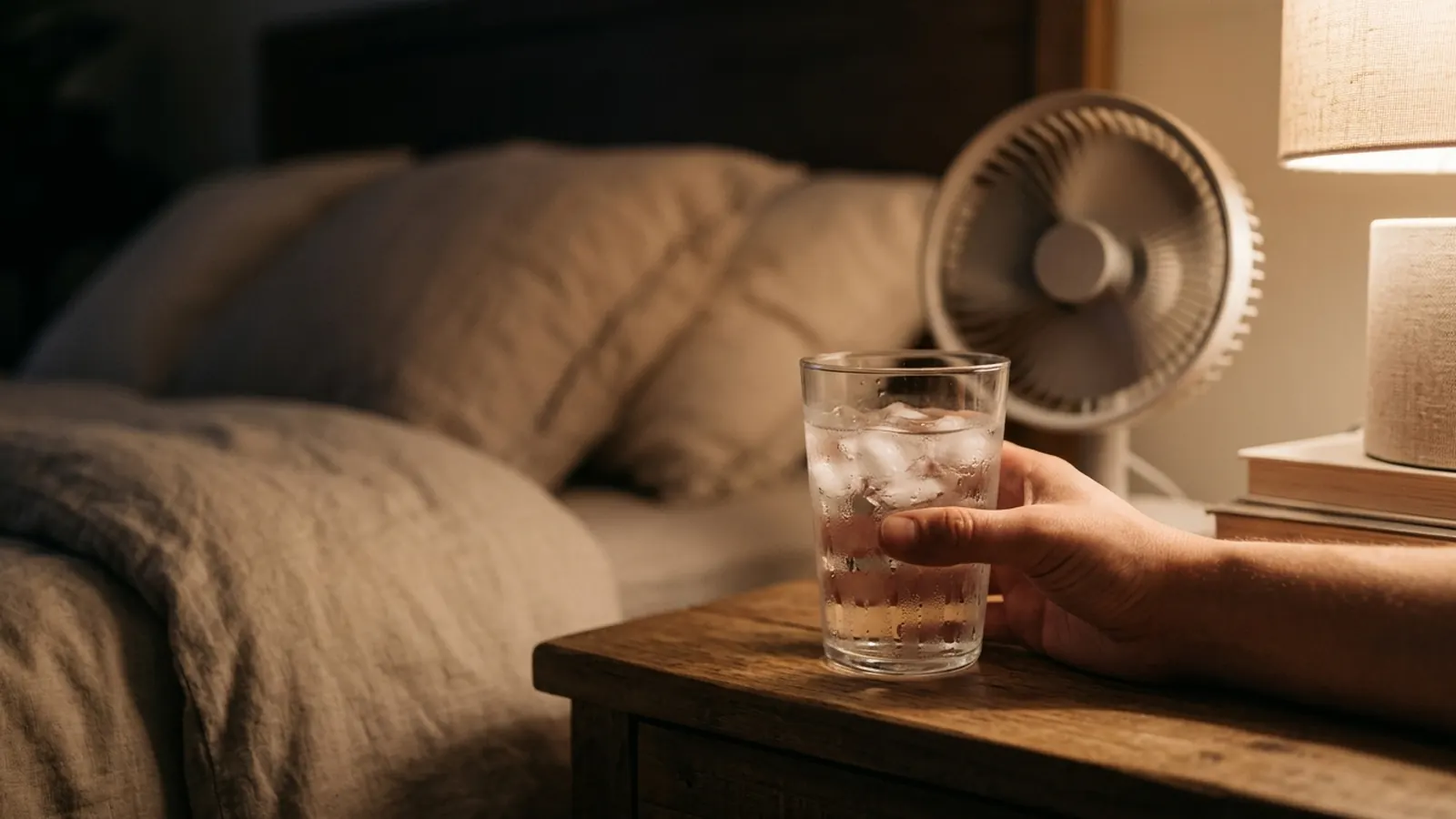
Hot flashes and night sweats are a major reason sleep breaks during the menopausal transition, and the research shows they are linked to insomnia. They are not the whole story, though. Treating the heat and treating the insomnia are separate jobs, and both have evidence behind them. [1][2] For the wider picture, start with perimenopause insomnia.
What the research says
The link between hot flashes and insomnia is strong. In a survey of 982 women aged 35 to 65, hot flashes at least three days a week were reported by 12.5% before menopause, 79.0% during perimenopause and 39.3% after it, and chronic insomnia symptoms climbed with hot flash severity, passing 80% in perimenopausal and postmenopausal women with severe hot flashes. [1] Among 72 women aged 43 to 57 recorded in a sleep lab, those with insomnia were more likely to have hot flashes the equipment detected, and a hot flash predicted more awakenings per hour. [3] In 28 healthy premenopausal women given a hormone-suppressing treatment that brought on hot flashes, 66% of recorded hot flashes fell within 5 minutes of an awakening and 80% came just before or during one. [4] A 2018 review concludes that many, but not all, hot flashes go with awakenings, and that the time awake they cause adds meaningfully to the night's total. [2] In plain terms, the sweats do break sleep, but they are not behind every waking.
The studies behind this
- Ohayon survey (2006): among 982 women aged 35 to 65, hot flashes at least three days a week were reported by 12.5% before menopause, 79.0% in perimenopause and 39.3% after menopause. Chronic insomnia symptoms rose with hot flash severity, reaching more than 80% in perimenopausal and postmenopausal women with severe hot flashes. [1]
- Sleep-lab study (Baker, 2015): among 72 women aged 43 to 57, those with insomnia were more likely to have objectively recorded hot flashes, and having a hot flash predicted more awakenings per hour of sleep. [3]
- Induced-hot-flash study (Bianchi, 2016): in 28 healthy premenopausal women who developed hot flashes after a hormone-suppressing treatment, 66% of recorded hot flashes came within 5 minutes of an awakening and 80% just before or during one. [4]
- Review (Baker, 2018): many, but not all, hot flashes are linked to awakenings in sleep recordings, and the time awake they cause adds meaningfully to total time awake at night. [2]
Does a hot flash wake you, or does waking make you notice the hot flash?
The research cannot yet say which comes first. In the induced-hot-flash study, hot flashes typically came before or at the same moment as an awakening. Hot flashes that the equipment detected were not linked to more shifts into lighter sleep, but those the women remembered were. The authors suggest that sleep disruption increases awareness and memory of nighttime hot flashes. [4] In practice that means a broken night can feel like a night of heat even if the recording shows fewer episodes. Some night waking is part of healthy sleep at any age; see is it normal to wake up at night, and for the second-half-of-the-night pattern specifically, waking at 3 a.m. in perimenopause.
What reduces hot flashes and night sweats?
The North American Menopause Society reviews the evidence in two position statements. This is what they say exists; none of it is advice for you personally, and every item is a conversation with your doctor.
- Menopausal hormone therapy (estrogen, with a progestogen for women who have a uterus). The society calls it the most effective treatment for hot flashes and night sweats. It says benefits and risks depend on type, dose, duration, timing, route and whether a progestogen is used, and that for women under 60 or within 10 years of menopause with no contraindications the balance is favourable for bothersome symptoms. It says treatment should be individualised. [5]
- Non-hormonal options with good evidence. The 2023 statement recommends cognitive behavioural therapy, clinical hypnosis, certain antidepressants (SSRIs and SNRIs), gabapentin, oxybutynin and fezolinetant for hot flashes and night sweats. [6] Fezolinetant is approved in Canada under the brand name Veozah. [11]
- Options it did not recommend. The panel did not recommend dietary supplements or herbal remedies, paced breathing, or several other approaches such as cooling techniques, avoiding triggers, exercise, yoga, relaxation, soy products, cannabinoids, acupuncture, and the medicines clonidine, pregabalin and suvorexant, judging that the evidence did not support recommending them for hot flashes. [6] The panel's judgement is a statement about the strength of evidence for reducing hot flashes. It is not proof that these options do not help any one person, and it is not proof that they are harmful.
Nothing above is advice to start, stop or change a medicine. That is a decision for you and your doctor or pharmacist.
What about the sleep itself?
Even with the heat treated, sleep trouble can persist. Cognitive behavioural therapy for insomnia (CBT-I, a structured treatment that changes the habits and thinking that keep insomnia going; the basics are in what is CBT-I) has been tested in women with hot flashes:
- In the MsFLASH trial, six telephone sessions of CBT-I improved insomnia scores more than a menopause-education control. Daily hot flash counts did not differ between the groups, but hot flash interference fell more with CBT-I. [7]
- In a pooled analysis of 546 women with hot flashes and insomnia symptoms, CBT-I had the largest effect on insomnia scores of the treatments compared, including hormone therapy. [8] See does CBT-I work for menopause insomnia.
- In a Detroit trial of postmenopausal women with insomnia, women whose insomnia remitted reported fewer daytime and nighttime hot flashes, although the reduction was not tied to one treatment. [9]
Can CBT work on the hot flashes themselves?
A separate type of CBT aimed at the hot flashes, not the insomnia, has been tested. In a randomised trial of 124 working women aged 45 to 60 with 10 or more problematic hot flashes and night sweats a week, a self-help booklet reduced how much the symptoms bothered them and how often they occurred, and improved sleep, compared with a waiting-list group, at 6 and 20 weeks. [10] The society's 2023 statement counts cognitive behavioural therapy among the recommended non-hormonal options. [6]
When to see a doctor
- Very frequent or severe sweats, or sweats that disturb your days. The Ohayon authors recommend that hot flashes be checked for in any woman with insomnia, since treating them could improve sleep. [1]
- Snoring, breathing pauses or daytime sleepiness. These can point to sleep-disordered breathing, which is more common after menopause. [2]
- Any doubt about whether your sweats are menopausal. Ask your doctor.
For what to do in the moment when a sweat has woken you and sleep will not come back, see can't sleep? what to do in the middle of the night.
Where evidence is thinner
- Hot flashes that women report and hot flashes that equipment records did not relate to sleep in the same way in the induced-hot-flash study. [4]
- The induced-hot-flash study used healthy younger women. [4]
- The self-help booklet trial compared against a waiting list, so some of the benefit may be attention and expectation. [10]
- The menopause society's ratings describe how strong the evidence is for reducing hot flashes. They do not tell you what is best for your own health. [6]
Where does this leave you?
Waking drenched is real and so is the way it can turn into long, tiring nights. Small Hours turns a nightly sleep diary into a plan built around your own sleep, to help you reclaim your days. You can sign up at trysmallhours.com.
General education, not medical advice.
References
- Ohayon MM. Severe hot flashes are associated with chronic insomnia. Arch Intern Med. 2006;166(12):1262-1268. Source for reference 1 (opens in a new tab)
- Baker FC, de Zambotti M, Colrain IM, Bei B. Sleep problems during the menopausal transition: prevalence, impact, and management challenges. Nat Sci Sleep. 2018;10:73-95. Source for reference 2 (opens in a new tab)
- Baker FC, Willoughby AR, Sassoon SA, Colrain IM, de Zambotti M. Insomnia in women approaching menopause: beyond perception. Psychoneuroendocrinology. 2015;60:96-104. Source for reference 3 (opens in a new tab)
- Bianchi MT, Kim S, Galvan T, White DP, Joffe H. Nocturnal hot flashes: relationship to objective awakenings and sleep stage transitions. J Clin Sleep Med. 2016;12(7):1003-1009. Source for reference 4 (opens in a new tab)
- The 2022 hormone therapy position statement of The North American Menopause Society. Menopause. 2022;29(7):767-794. Source for reference 5 (opens in a new tab)
- The 2023 nonhormone therapy position statement of The North American Menopause Society. Menopause. 2023;30(6):573-590. Source for reference 6 (opens in a new tab)
- McCurry SM, Guthrie KA, Morin CM, et al. Telephone-based cognitive behavioral therapy for insomnia in perimenopausal and postmenopausal women with vasomotor symptoms: a MsFLASH randomized clinical trial. JAMA Intern Med. 2016;176(7):913-920. Source for reference 7 (opens in a new tab)
- Guthrie KA, Larson JC, Ensrud KE, et al. Effects of pharmacologic and nonpharmacologic interventions on insomnia symptoms and self-reported sleep quality in women with hot flashes: a pooled analysis of individual participant data from four MsFLASH trials. Sleep. 2018;41(1):zsx190. Source for reference 8 (opens in a new tab)
- Kalmbach DA, Cheng P, Arnedt JT, et al. Improving daytime functioning, work performance, and quality of life in postmenopausal women with insomnia: comparing cognitive behavioral therapy for insomnia, sleep restriction therapy, and sleep hygiene education. J Clin Sleep Med. 2019;15(7):999-1010. Source for reference 9 (opens in a new tab)
- Hardy C, Griffiths A, Norton S, Hunter MS. Self-help cognitive behavior therapy for working women with problematic hot flushes and night sweats (MENOS@Work): a multicenter randomized controlled trial. Menopause. 2018;25(5):508-519. Source for reference 10 (opens in a new tab)
- Health Canada. Drug Product Database: Veozah (fezolinetant), DIN 02553600, Astellas Pharma Canada Inc. Accessed 7 October 2026. Source for reference 11 (opens in a new tab)
This article is general education, not medical advice. It cannot diagnose anything or replace a conversation with your doctor. Read how we choose and check sources on the how we write page.